Modi Hair Plant
Hair Follicle Stem Cell Therapy
A non-surgical treatment that injects your own hair follicle stem cells into the scalp, without transplantation
NON-SURGICAL THERAPY
Stem cell hair loss treatment without surgery
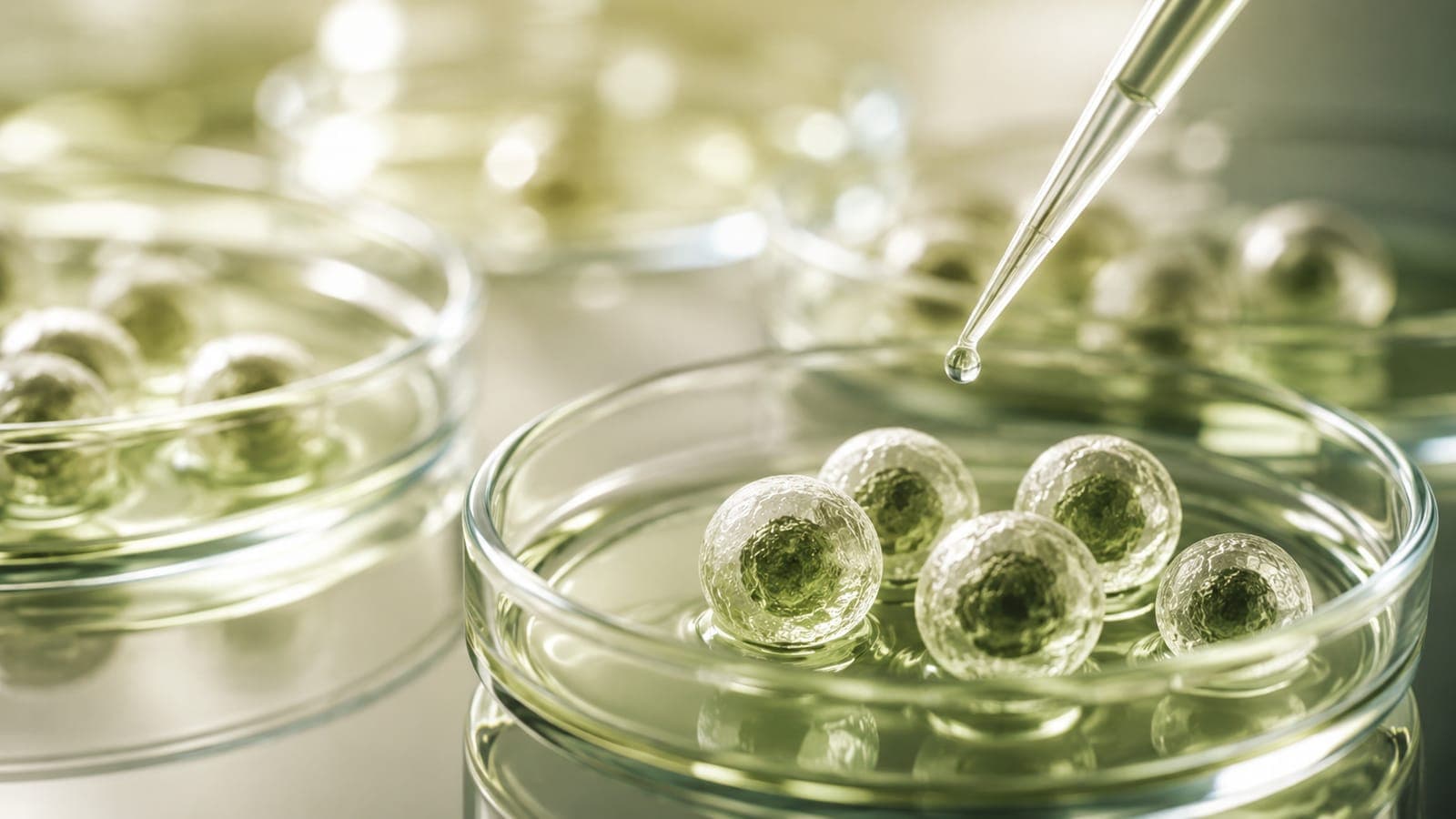
Hair follicle stem cell therapy is a non-surgical treatment that separates only the stem cells from your own hair follicles and injects them directly into the scalp where hair loss has progressed. Unlike a transplant that relocates hair, it involves less burden from incisions or harvest scars, and because it uses your own cells, it is safe.
WHY IT WORKS
Hair loss is a state in which hair follicle stem cells have declined
The black hair we can see is a structure of dead cells stacked layer upon layer, while the stem cells that actually create the follicle surround its root. Because these cells divide continuously, hair grows back in the same spot even after a hair is pulled out.
Hair loss is a state in which the number and activity of these hair follicle stem cells have declined. Even on the same scalp, the stem cells at the back of the head and in the beard area remain healthy, while those at the crown and the M-shaped areas show a marked decline in number and activity. For this reason, moving healthy stem cells from the back of the head to areas where hair loss has progressed can be expected to stimulate atrophied follicles and bring about improvement.
WHO IT'S FOR
Recommended for the following
Those who want a non-surgical treatment
Female-pattern hair loss with overall thin, weak hair, and those whose hair density and thickness have decreased.
Those hesitant about or unsuited to a transplant
Those who need active treatment but find surgery burdensome, and those for whom a transplant is difficult due to weak follicles.
Those looking to complement a transplant
Those concerned about recovery and care after a hair transplant, and those who want to also manage hair loss in areas not operated on.
The cases that call for a hair transplant and those that call for stem cell therapy are clearly different. Since the appropriate treatment varies with the condition of the scalp and hair loss, we recommend choosing after a diagnosis.
SELF-CHECK
Could this be you? A quick self-check
- My hair feels thinner overall
- My hair has become finer and limp (less volume when styling)
- My crown or part line shows through more than before
- I'm shedding more hair than before
- I want active treatment but find surgery (a transplant) burdensome
- After a hair transplant, I also want to manage the non-surgical areas
If any of these apply, non-surgical stem cell therapy may be worth considering. This self-check is for reference only; whether it actually suits you is decided after a diagnosis of your scalp and hair-loss condition.
FROM YOUR OWN FOLLICLE
We revive stem cells from follicles that would be discarded
A hair transplant only relocates follicles; it cannot increase the total number of hairs. Stem cell therapy complements this limitation. Among harvested follicles, the “poor follicles” — gray, curly, or damaged during harvesting — are not suitable for transplantation, but the stem cells that create follicles are still alive within them.
Modi Hair Plant does not simply grind this tissue into a solution. At its in-house hair follicle stem cell research center, specialized researchers separate only the stem cells using a scientifically established protocol, inspect the cell count and condition under a microscope, and then inject them into the patient's own scalp. This approach of separating and applying stem cells from one's own tissue is called HTE (autologous tissue engineering), and studies reporting excellent clinical results have been published. The institute's follicle separation and inspection process is detailed on a separate page.
Hair Follicle Stem Cell Lab
See our follicle separation, inspection, and preservation research in detail.
Visit the labBEFORE / AFTER
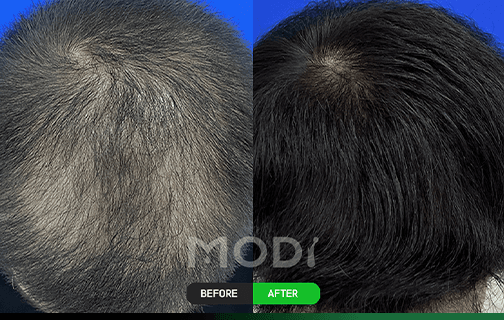
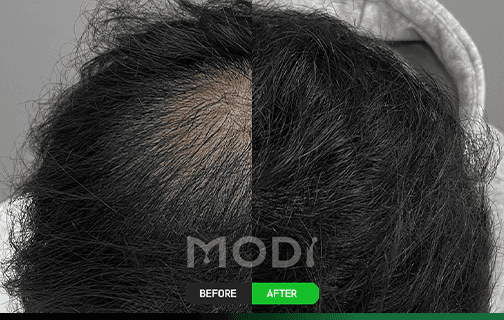
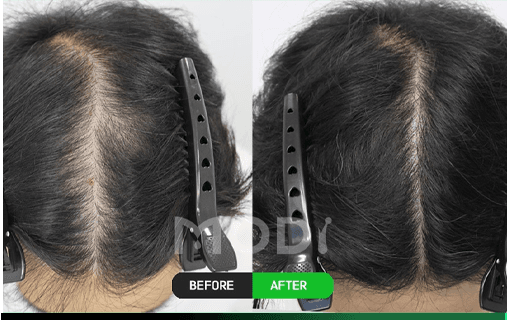
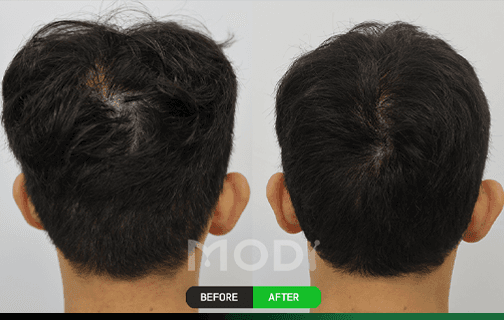
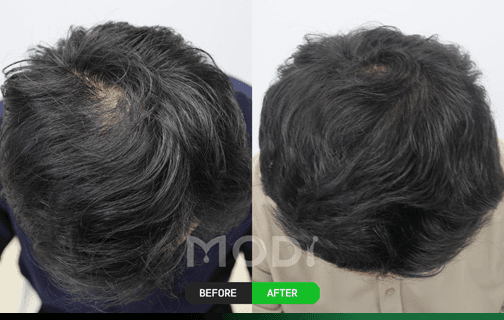
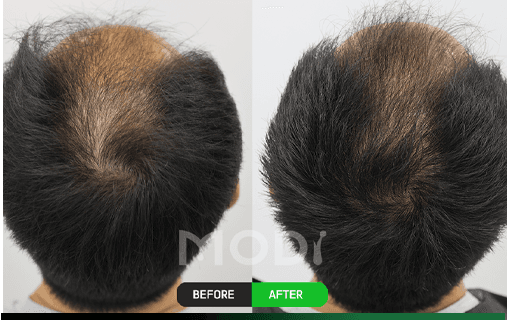
Hair follicle stem cell therapy before and after
HOW IT DIFFERS
How it differs from exosomes and Regenera
If you are considering stem cell therapy for hair loss, you should examine what is extracted from where, and where it is injected. Modi injects autologous stem cells separated from your own hair follicles directly into the scalp.
| Category | Source / method | Limitation |
|---|---|---|
| Modi · hair follicle stem cell injection | Stem cells are separated from your own hair follicles and injected directly into the dermal layer. Exosomes cultured from your own follicle cells are also used. | Requires in-house separation and inspection facilities and specialized researchers |
| Exosome | Signaling vesicles separated from the culture medium of another person's stem cells such as fat, blood, or cord blood. Most of what is distributed domestically is a cosmetic for external use. | The FDA does not recommend allogeneic exosomes, and follicle-derived exosome products are not yet on the market |
| Regenera (kit type) | Scalp tissue is harvested with a 2.5 mm punch, ground with physiological saline, filtered, and injected. | Only part of the stem cells is recovered, and scarring may remain at the harvest site |
An exosome is a signaling vesicle secreted by cells, and what is inside it is the key point. Without an explanation of which cell line was cultured and for how many passages, it is difficult to assert an effect based on the delivery vehicle of an “exosome” alone.
PROCESS
The treatment process — injected, not applied
Applying stem cell ampoules or shampoo to the surface of the skin results in a markedly low absorption rate, making it difficult to reach the follicle cells. Hair follicle stem cell therapy is a method of administering cultured follicle-derived cells directly into the deep dermal layer where the hair roots are located. Because it improves the environment around the follicle immediately, an effect can be expected only when a specialist performs the procedure by injecting at the precise location.
- 01
1:1 consultation and examination
We diagnose the appropriate treatment by examining the condition of the scalp and hair loss.
- 02
Follicle harvesting
We harvest your own healthy follicles.
- 03
Stem cell separation and inspection
At the research center, we separate the stem cells and check the cell count and condition under a microscope.
- 04
Scalp injection
We inject the separated stem cells directly into the dermal layer of the hair loss area.
It is rare that hair loss can be resolved by surgical treatment alone. Since hair care continues throughout life, considering non-surgical and surgical treatments together leads to a better long-term condition of the scalp and hair.
TREATMENT INFO
Treatment at a glance
| Item | Details |
|---|---|
| Procedure time | About 3 hours on the first day / follow-up culture-media care takes 30 min–1 hour per session |
| Treatment plan | One follicle harvest + about 12–20 culture-media care sessions (varies by individual) |
| Visit interval | Usually every 2–4 weeks (every 3 weeks recommended at first) |
| Anesthesia | First day: local anesthesia + conscious sedation / no anesthesia for culture-media care |
| Return to daily life | You can return to daily life right after the procedure |
| Optional add-on care | Minoxidil or dutasteride injections may be combined depending on your condition |
FOLLOW-UP CARE
Care continues with culture media
At Modi Hair Plant, we culture a portion of the harvested hair follicle stem cells to obtain culture media, which contains bioactive substances involved in follicle growth. After the stem cell injection, you visit every 2–4 weeks for culture-media care (a hair spa) that delivers, to the scalp, the bioactive substances secreted by your own follicle cells. It is a process for continuing care of the scalp and follicle environment after stem cell therapy, and responses vary by individual.
TIMELINE
How the progress unfolds over time
- 01
Right after ~ 3 months
This is the period when the stem cells act on the scalp and the environment around the follicles, so visible hair change may still be small. Enough rest, scalp care, and care following the medical team's guidance are important.
- 02
3 ~ 6 months
As the hair growth cycle stabilizes, changes in the thickness and density of existing hair may gradually be observed. The degree and timing of change vary by individual, and we check the treatment response through regular follow-up.
- 03
After 6 months
This is when we assess the treatment response and overall hair condition to plan maintenance. We help maintain a healthy hair environment through continued scalp care, lifestyle improvements, and maintenance treatment if needed.
The course above is general guidance; the degree and timing of change vary by individual.
FAQ
Frequently asked questions
QHow is hair follicle stem cell therapy different from a hair transplant?
AA hair transplant is surgery that relocates and plants follicles, while hair follicle stem cell therapy is a non-surgical treatment that separates only the stem cells from your own follicles and injects them directly into the scalp where hair loss has progressed. A transplant only repositions follicles and cannot increase the total number of hairs; stem cell therapy complements this limitation.
QWho is it recommended for?
AIt can be considered for those whose hair is generally fine and weak, those who need active treatment but find surgery burdensome or whose follicles are too weak for a transplant, and those who want to manage aftercare or areas that were not operated on as well. Whether it suits you, however, is decided after a diagnosis.
QWhat is the difference between topical (applied) products and an injection?
AApplying ampoules or shampoos to the surface of the skin gives low absorption, so it is hard to reach the hair roots. Hair follicle stem cell therapy is a method for delivering the separated cells directly into the dermal layer where the hair roots sit.
QIs it the same as exosome therapy?
ANo. Exosomes are signaling vesicles secreted by cells; most exosome products distributed in Korea are cosmetic topical agents, and follicle-derived exosome products are not yet on the market. Modi Hair Plant injects autologous stem cells separated from your own follicles directly into the scalp.
QWhat kind of cells are used?
AAutologous cells separated from your own follicles are used. The separated stem cells are inspected under a microscope for cell count and condition before being injected, and whether it suits you and any precautions are confirmed during consultation, depending on your scalp and health condition.
QCan it be done together with a hair transplant?
AYes, it is sometimes done together. Combining the two may be chosen to help manage the post-surgery period or areas that were not operated on, and which combination suits you is decided after a diagnosis based on your scalp and hair-loss condition.
QHow long does the procedure take?
AOn the first day, from follicle harvesting to stem cell separation and injection takes about 3 hours. After that, culture-media care takes about 30 minutes to 1 hour per session.
QHow many sessions are needed?
AThe follicle harvest is done once; after that, culture-media care is usually done every 2–4 weeks, about 12–20 times. The number varies by individual and condition, and the right plan is decided after a diagnosis.
CONSULT
The right approach for you, starting with a diagnosis
Whether non-surgical stem cell therapy is right for you, or whether it should be combined with a hair transplant, depends on the condition of your scalp and hair loss. Start with an accurate diagnosis.